

Introduction
Artificial Intelligence (AI) is no longer a futuristic concept. It is already part of everyday life. Whether you unlock your smartphone using facial recognition, receive personalized recommendations on Netflix, or use a virtual assistant, AI is working behind the scenes.
Over the last decade, artificial intelligence has transformed industries including healthcare, finance, education, manufacturing, and transportation. As technology continues to evolve, understanding AI is becoming increasingly important for students, professionals, business owners, and everyday users.
This complete guide explains what artificial intelligence is, how it works, its major types, benefits, risks, real world applications, and what the future may hold.
Table of Contents
- What Is Artificial Intelligence?
- How Does Artificial Intelligence Work?
- Types of Artificial Intelligence
- Real World Applications of AI
- Benefits of Artificial Intelligence
- Risks and Challenges of AI
- Future of Artificial Intelligence
- Frequently Asked Questions
- Conclusion
What Is Artificial Intelligence?
Artificial Intelligence is a branch of computer science focused on building systems that can perform tasks normally requiring human intelligence. These tasks include learning, reasoning, problem solving, language understanding, decision making, and pattern recognition.
Traditional software follows fixed instructions. AI systems are different because they can analyze data, identify patterns, and improve their performance over time.
For example, when YouTube recommends videos based on your viewing history, AI algorithms are helping determine what content you are most likely to watch next.

How Does Artificial Intelligence Work?
Artificial intelligence works through a combination of data, algorithms, and computing power. AI systems learn from large amounts of information and use that knowledge to make predictions or decisions.
The process generally involves collecting data, training an AI model, testing the model, and then using it in real world situations.
Machine learning is one of the most common approaches used in AI development. Instead of manually programming every possible outcome, machine learning systems learn from examples and improve their accuracy over time.
Types of Artificial Intelligence
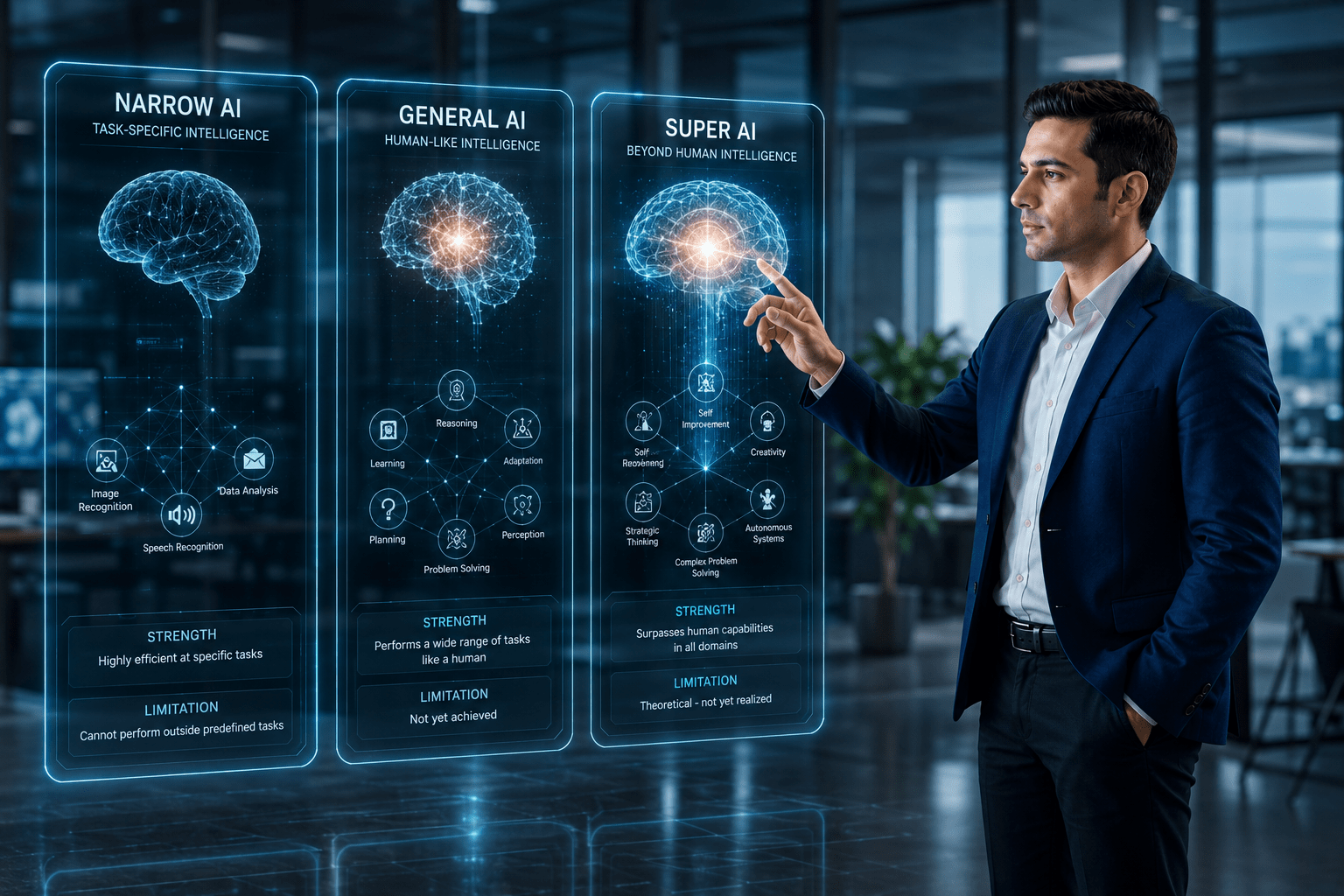
Artificial intelligence can be classified into several categories based on its capabilities.
Narrow AI
Narrow AI is designed to perform specific tasks. This is the type of AI used today in applications such as voice assistants, recommendation engines, image recognition systems, and chatbots.
General AI
General AI refers to a theoretical system capable of performing any intellectual task that a human can do. Researchers continue exploring this concept, but it does not currently exist.
Super AI
Super AI is a hypothetical future form of intelligence that could surpass human capabilities in almost every field. While often discussed in science fiction, it remains theoretical.
Real World Applications of Artificial Intelligence
AI is being used across many industries to improve efficiency, accuracy, and decision making.

Healthcare
Healthcare providers use AI for medical imaging, disease prediction, patient monitoring, and drug research. AI helps doctors analyze large amounts of data faster, leading to better insights and improved patient care.

Business
Businesses use AI for customer service automation, data analysis, fraud detection, and marketing optimization. AI powered tools help organizations save time and make smarter decisions.

Education
Educational platforms use AI to personalize learning experiences, recommend study materials, and help students learn more effectively.

Benefits of Artificial Intelligence
Increased Efficiency
AI can automate repetitive tasks, allowing people to focus on more valuable work.
Better Decision Making
By analyzing large amounts of data, AI helps organizations make informed decisions.
Improved Customer Experience
AI powered systems can provide personalized recommendations and faster support.
Enhanced Innovation
AI enables researchers and businesses to develop new products, services, and solutions.

Risks and Challenges of AI
Despite its benefits, artificial intelligence also presents challenges.
Privacy Concerns
AI systems often require large amounts of user data, raising concerns about privacy and data protection.
Job Displacement
Some repetitive jobs may become automated, requiring workers to develop new skills.
Ethical Issues
Bias in training data can lead to unfair outcomes, making responsible AI development essential.
Conclusion
Artificial intelligence is transforming the way people live and work. From healthcare and education to business and entertainment, AI is creating opportunities that were once impossible.
While challenges such as privacy, ethics, and job displacement remain important considerations, the potential benefits of AI are significant. Understanding how artificial intelligence works today can help individuals and businesses prepare for the technology driven future ahead.