Introduction
Artificial Intelligence (AI) and Machine Learning (ML) are two of the most talked about technologies today. They power recommendation systems, virtual assistants, fraud detection tools, healthcare innovations, and many other modern applications.
Because the terms are often used together, many people assume they mean the same thing. However, AI and Machine Learning have different meanings and play different roles in modern technology.
Understanding this difference helps students, professionals, and business owners make better sense of today’s rapidly evolving digital landscape.
If you’re new to AI, it’s worth reading our What Is Artificial Intelligence? guide before diving deeper into this topic.
What Is Artificial Intelligence?
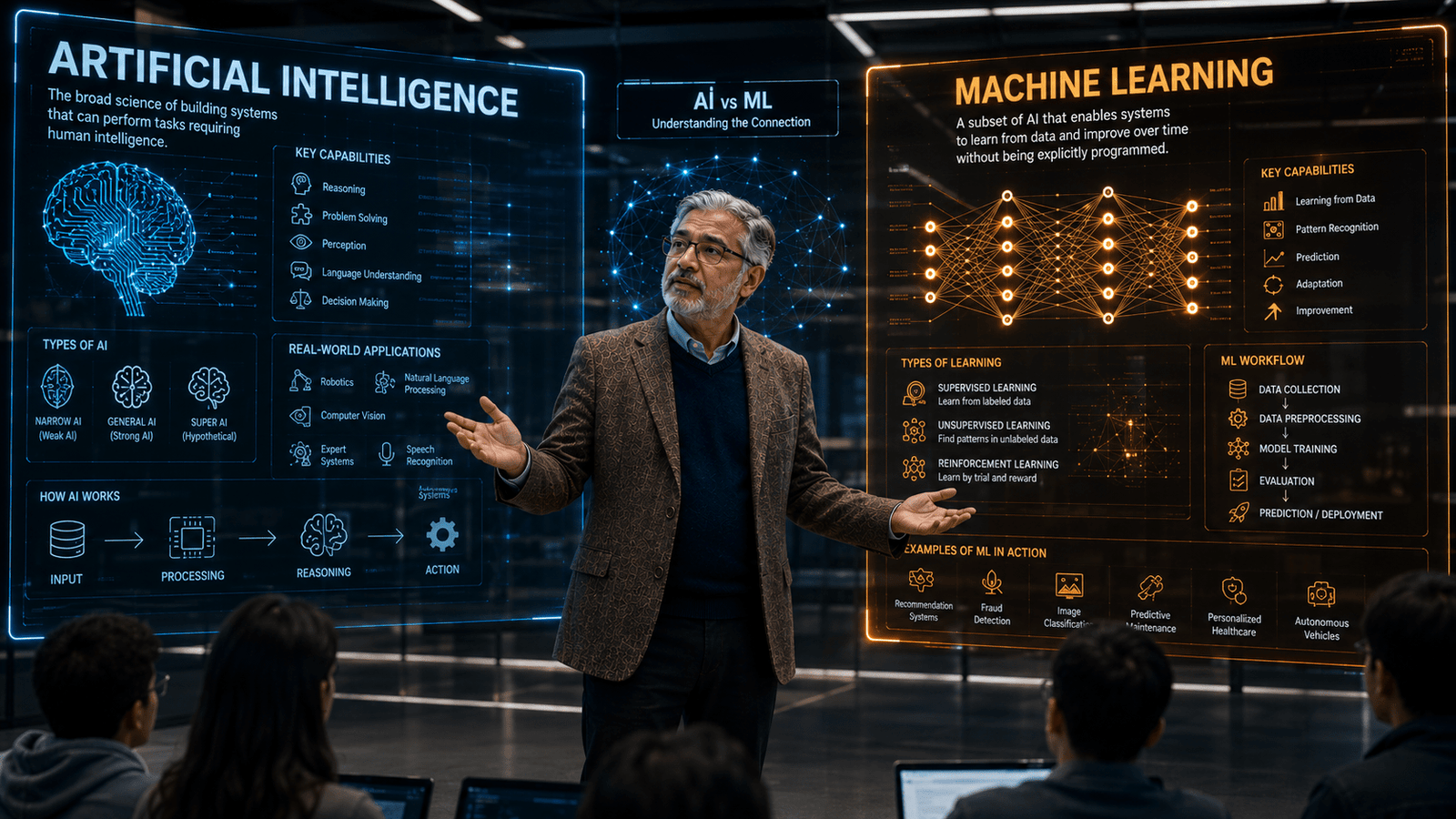
Artificial Intelligence is the broader concept of creating machines and software that can perform tasks normally requiring human intelligence.
These tasks include:
• Problem solving
• Language understanding
• Decision making
• Image recognition
• Learning from experience
The goal of AI is to create systems capable of behaving intelligently and assisting humans in solving complex problems.
Readers looking for a complete overview of AI should explore our Artificial Intelligence Complete Guide.
According to Artificial Intelligence, AI systems use data, algorithms, and computing power to simulate intelligent behavior.

What Is Machine Learning?
Machine Learning is a subset of Artificial Intelligence.
It allows computers to learn from data without being explicitly programmed for every possible situation.
Instead of following fixed instructions, machine learning algorithms identify patterns in data and use those patterns to make predictions or decisions.
For example, when Netflix recommends movies based on your viewing history, machine learning algorithms are helping generate those recommendations.
Google’s Machine Learning Crash Course provides an excellent introduction to how machine learning models work.

AI vs Machine Learning: The Key Difference
The simplest way to understand the difference is:
Artificial Intelligence is the overall goal.
Machine Learning is one of the methods used to achieve that goal.
Think of AI as the entire vehicle and machine learning as the engine powering many of its capabilities.
Example
Suppose a company wants software that can identify cats in photographs.
The AI goal is to recognize cats.
Machine Learning helps achieve that goal by training the system on thousands of cat images until it learns the patterns itself.
This is why machine learning is considered a subset of AI rather than a separate technology.
Real World Examples of Artificial Intelligence
Artificial Intelligence is used in many technologies people interact with every day.
Voice Assistants
Virtual assistants understand voice commands and respond to user requests.
Smart Recommendation Systems
Streaming services recommend content based on user preferences.
Language Translation
Translation tools can instantly convert text between different languages.
Customer Support Chatbots
Businesses use AI to answer customer questions and improve support efficiency.
Real World Examples of Machine Learning
Machine learning powers many modern applications.
Fraud Detection
Banks use ML models to identify suspicious transactions.
Email Spam Filtering
Machine learning helps detect unwanted emails.
Product Recommendations
Online stores use machine learning to recommend products.
Predictive Analytics
Organizations use ML to forecast trends and future outcomes.
Google offers detailed resources on machine learning models and their practical applications.
Benefits of Artificial Intelligence
Artificial Intelligence offers several important advantages.
Increased Efficiency
AI can automate repetitive tasks.
Better Decision Making
AI systems analyze large amounts of information quickly.
Improved Customer Experiences
Organizations can deliver more personalized services.
Faster Innovation
AI helps accelerate research and development.
Benefits of Machine Learning
Machine learning provides its own unique advantages.
Continuous Improvement
ML systems improve as they receive more data.
Accurate Predictions
Machine learning identifies patterns humans might miss.
Scalability
ML models can process massive datasets efficiently.
Data Driven Insights
Organizations can discover valuable opportunities hidden within data.
Why People Often Confuse AI and Machine Learning
Many modern AI systems rely heavily on machine learning.
When users interact with recommendation engines, chatbots, and image recognition tools, machine learning is often working behind the scenes.
Because machine learning has become one of the most visible AI technologies, people frequently use both terms interchangeably.
However, understanding the distinction helps build a stronger foundation for learning more advanced AI concepts.
The Future of AI and Machine Learning
AI and Machine Learning are expected to become even more important in the coming years.
Healthcare, education, cybersecurity, finance, manufacturing, and scientific research are already benefiting from these technologies.
Frequently Asked Questions
Is machine learning the same as AI?
No. Machine learning is a subset of Artificial Intelligence.
Can AI exist without machine learning?
Yes. AI includes many approaches besides machine learning.
Which is more important?
Both are important because machine learning helps power many modern AI systems.
Is ChatGPT AI or machine learning?
ChatGPT is an AI application built using machine learning and deep learning technologies.
Conclusion
Artificial Intelligence and Machine Learning are closely connected but not identical.
AI is the broader goal of creating intelligent systems, while machine learning is one of the methods used to achieve that goal.
Understanding the difference helps individuals and businesses better understand the technologies shaping the future.