You don’t need to quit the internet. You just need a few smart habits and the right information.
Quick Answer if You’re in a Hurry
Quick answer if you’re in a hurry: AI voice scams and deepfakes are real and growing. Your best defenses right now are a family safe word, knowing the visual tells of a fake video, locking down your social media, and setting firm screen-time limits. Keep reading for how to do each one.
Picture this. Your phone rings. It’s your daughter’s voice, and she sounds terrified. She says she’s been in an accident and needs you to wire money immediately. You’re shaking. You almost do it.
Then she texts you from a totally different number. She’s fine. She’s at the grocery store. The call was fake.
This isn’t a TV thriller plot. It happened to a grandmother in Arizona last year. It’s happening to families across the country right now, and the technology behind it is getting cheaper and easier to use every single week.
If you’ve been feeling a low-grade, constant anxiety about what AI can do, you’re not overreacting. Digital anxiety is real, it has a name, and a lot of people are living with it quietly. But here’s the honest truth: you don’t need to be a tech expert to protect yourself. You just need a few simple habits, and you need them today.
$1.1B
Lost to impersonation scams in the US in 2023 (FTC)
3 sec
Time needed to clone a voice with today’s AI tools
68%
Of Americans say they’re worried about online privacy
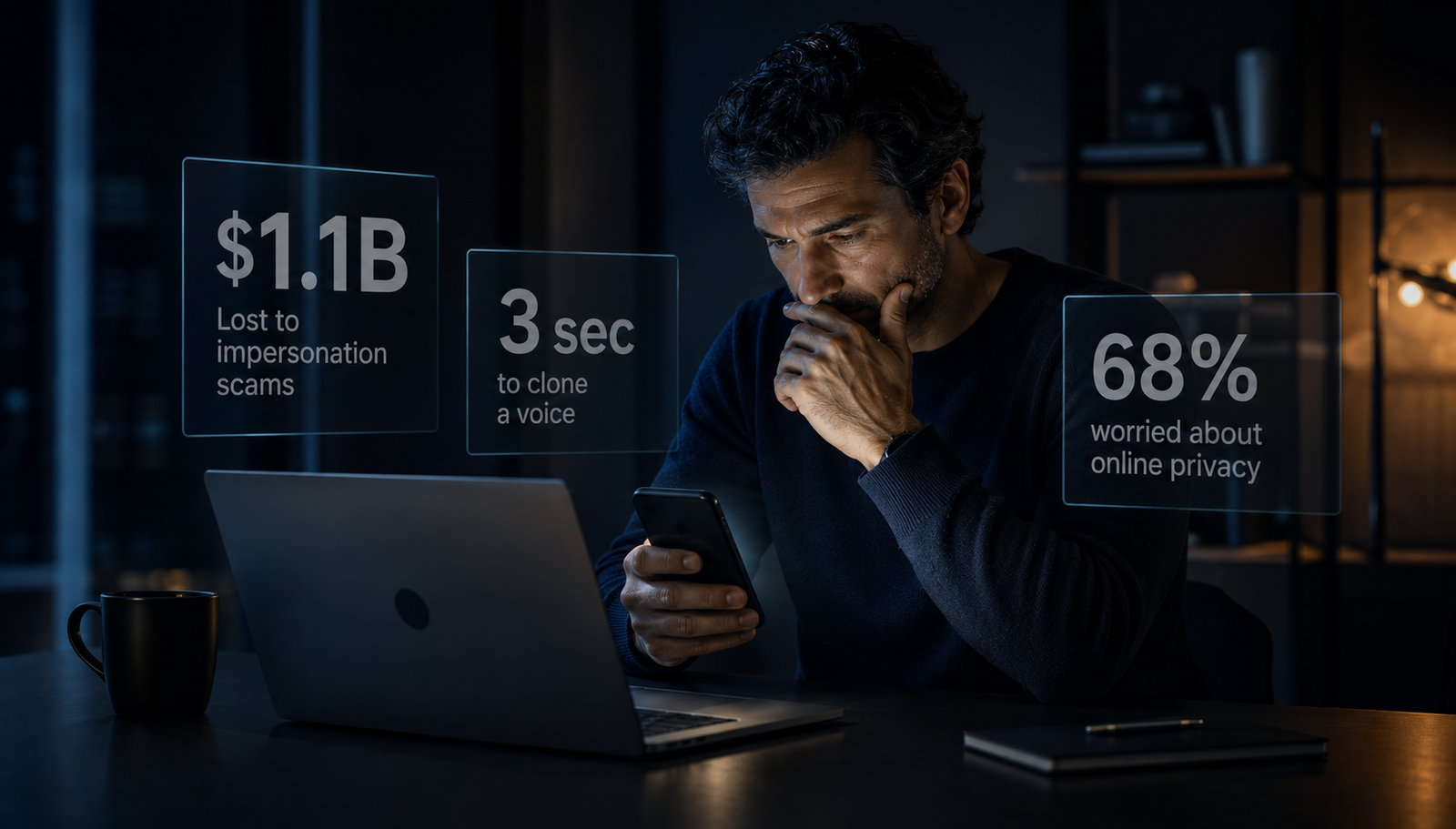
Why AI Progress Is Triggering Real-World Anxiety
Two years ago, a “deepfake” required a Hollywood-level budget and a team of engineers. Today, anyone with a laptop and a free app can clone a voice, create a realistic video of someone saying something they never said, or generate a fake photo that passes every eyeball test.
That shift happened fast. Uncomfortably fast. And most people’s awareness of what’s possible hasn’t caught up yet. That gap between what the tech can do and what the average person expects, that’s where scammers live.
The Rise of Hyper-Realistic Deepfakes and Clone Voices
AI voice cloning tools can now produce a convincing copy of someone’s voice from as little as three to ten seconds of audio. And that audio? It’s sitting all over the internet. A birthday video on Facebook. A TikTok. A voicemail someone left posted as a meme. Scammers are collecting this without anyone noticing.
Deepfake videos are similar. A scammer can now take a public photo or short video clip and generate a fake video of that person delivering any message they want. Some of these videos are shockingly convincing at first glance.
Real-world example: In early 2024, a finance worker in Hong Kong was tricked into transferring $25 million after joining a video call where every person he saw, including his “CFO,” was a deepfake. The call looked normal. The faces looked normal. The whole thing was AI-generated.
These aren’t edge cases. They’re becoming textbook scam playbooks, and knowing they exist is the first step to not falling for them.
Constant Connectivity and the Feeling of Losing Data Privacy
Beyond the scams, there’s another layer of digital anxiety that’s harder to pin down. It’s the feeling that everything you do online is being watched, stored, and used in some way you didn’t agree to. Because honestly? A lot of it is.
Your phone knows where you sleep. Your apps know what you search at 2 AM. Your smart speaker is technically always listening. None of that is a conspiracy theory. It’s just how the current version of the internet works.
That constant awareness, that sense of zero privacy, wears on people. It’s not paranoia. It’s a reasonable response to the actual situation. The good news is that you have more control than most people think.

4 Practical Steps to Outsmart AI Scams and Reclaim Peace
These aren’t complicated. You don’t need to understand how the technology works. You just need to build a few habits, the same way you got used to buckling your seatbelt without thinking about it.
01. Set Up a Family Safe Word
This is the single most effective thing you can do right now, and it takes about five minutes. A family safe word is a simple, private verbal password that you agree on with your close family members. If you ever get a distressed call from a family member asking for money or help, you ask for the safe word. A real person knows it. An AI-cloned voice never will.
Pick something random and not obvious. “Pineapple” is fine. “Grandma’s maiden name plus a number” is even better. The key is that it’s not something a scammer could guess from your social media.
- Pick a word that’s not on your Facebook. Nothing connected to birthdays, pet names, or anniversaries.
- Tell immediate family only. This isn’t for group chats. Keep it small and private.
- Practice using it. Run a fake drill so everyone feels comfortable asking without embarrassment in a real emergency.
- Change it once a year or if you suspect it’s been compromised.
This one habit can stop the most emotionally manipulative AI scams cold. Scammers bank on panic making you skip verification. A safe word interrupts that panic with a simple, calm checkpoint.

02. Spot the Red Flags in AI Videos
Learning how to spot deepfakes doesn’t require a film degree. Current AI video generation still has a handful of consistent weak spots, and once you know what to look for, you’ll start noticing them everywhere.
- Unnatural blinking. Real people blink about 15 to 20 times per minute. Early deepfakes often blink too little or in a robotic, regular pattern. Watch the eyes for 20 seconds.
- Weird lighting around the face. AI-generated faces sometimes have a slightly too-smooth look, almost like a Snapchat filter that can’t quite decide where the light is coming from. The edges of the face near the hairline or ears can look slightly blurry or “floaty.”
- Audio that doesn’t quite match the mouth. The lip-sync in many deepfakes is off by a fraction of a second, or the voice sounds slightly too clean, like it’s coming from a studio while the person is supposedly in a noisy room.
- Hands and teeth. AI still struggles with hands (odd finger counts, unnatural positions) and teeth (teeth can look unnaturally perfect or slightly blurred).
- When in doubt, find the original source. If a video claims to show a celebrity or public figure saying something shocking, search for the clip on their official channel before believing it.
You won’t catch every deepfake. Neither will professional fact-checkers. But these checks will protect you from the vast majority of scams circulating right now.
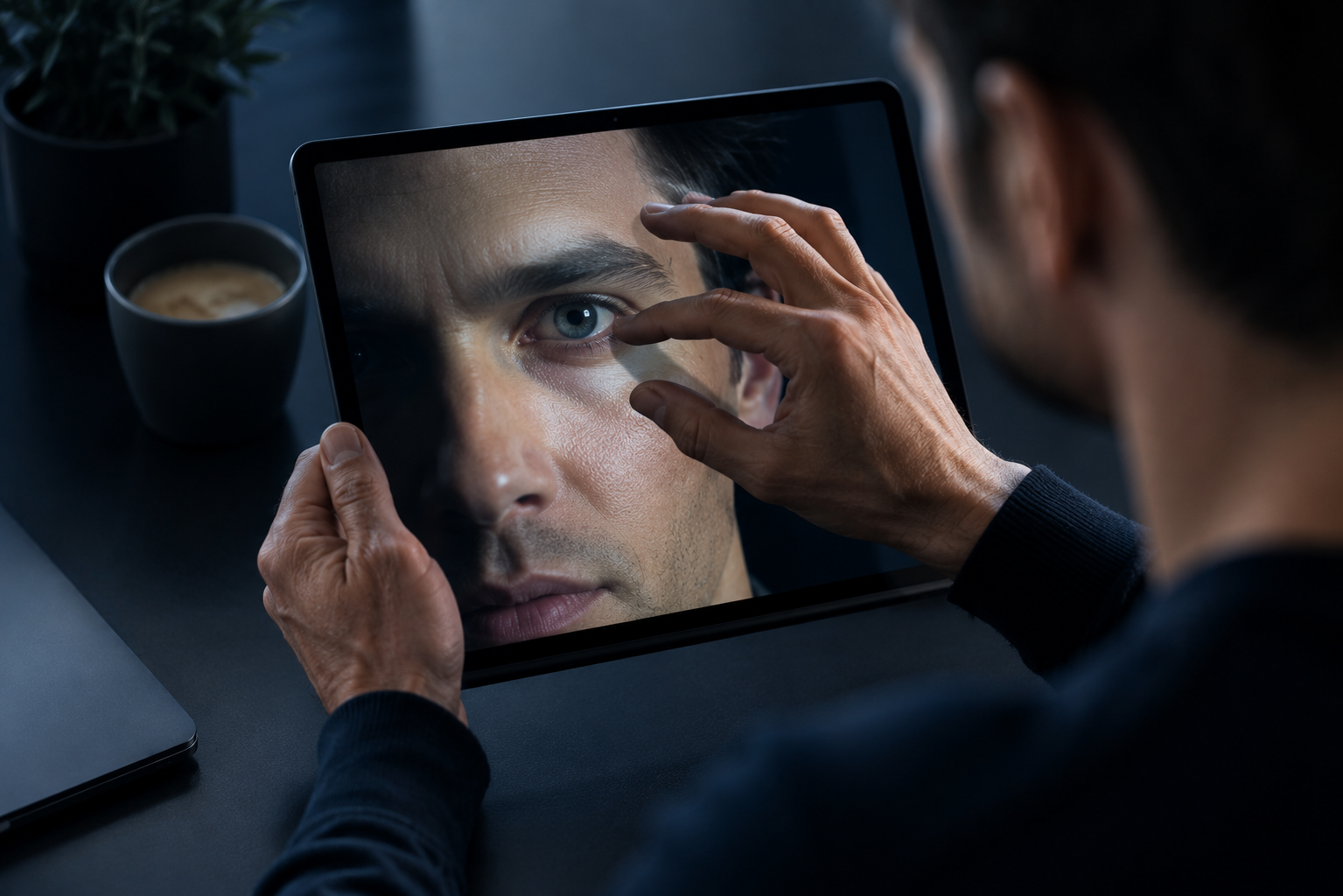
03. Audit Your Social Media Exposure
Your public social media is a free shopping mall for scammers. Every video where your voice is audible, every photo that shows your family, every post that mentions where you live or work is potential raw material for building a targeted scam against you.
Minimizing what’s publicly visible is one of the best ways to protect yourself from AI scams before they even start. You don’t have to delete everything. You just have to stop handing out free data.
- Set your Facebook, Instagram, and TikTok profiles to “Friends Only” or private. Do this today if you haven’t. It takes two minutes per platform.
- Delete or archive old videos where your voice is prominent. Voice cloning needs a sample. Less public audio means harder for scammers to work with.
- Stop posting your location in real time. Posting “at the airport!” tells everyone you’re not home. Post the vacation photos when you’re already back.
- Google yourself. Seriously. Search your full name and see what comes up. You might be surprised how much is publicly indexed. Sites like Spokeo or Whitepages compile data publicly and many allow opt-out requests.
- Review the apps that have access to your accounts. Go into your Facebook and Google settings and check which third-party apps have permission to see your data. Revoke anything you don’t recognize or actively use.
Privacy tip: On iPhone, go to Settings, Privacy, and Microphone or Camera, and you’ll see exactly which apps have access. On Android it’s Settings, Apps, and then Permissions. Turn off access for anything that doesn’t genuinely need it.
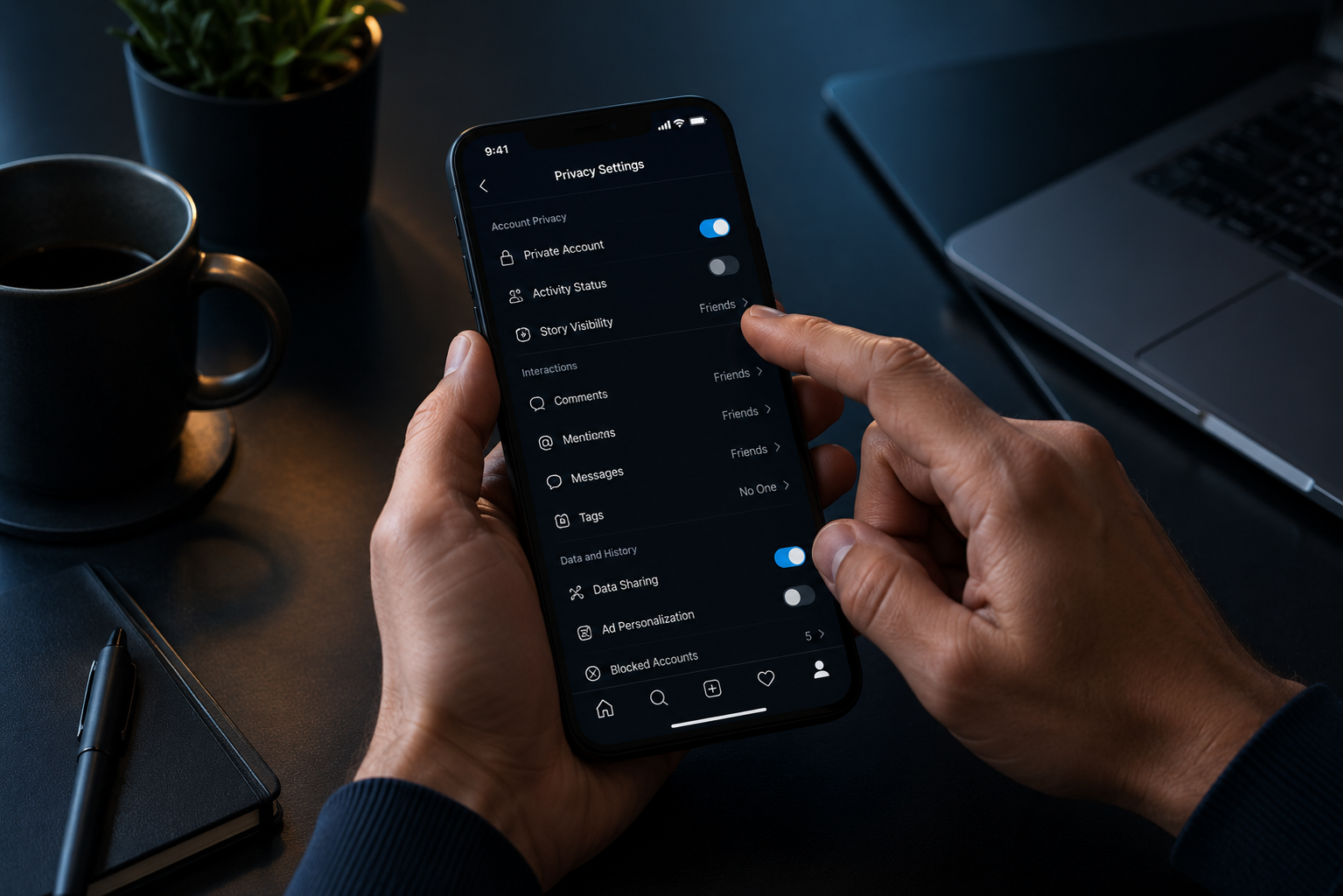
04. Practice a Digital Detox Rule
This one is about your mental health as much as your security. Managing digital anxiety and screen time aren’t separate issues. The more time you spend scrolling, the more alarming content the algorithm feeds you, and the more anxious you get about a world that feels out of control. It’s a cycle, and breaking it on your terms makes a real difference.
You don’t need a full “social media cleanse.” Small, firm rules go a long way.
- No phones for the first 30 minutes of the morning. Starting your day with news or social media primes your brain for anxiety before you’ve even had coffee. Try reading, stretching, or just sitting quietly instead.
- Set a daily screen time limit on your phone. Both iPhone (Screen Time in Settings) and Android (Digital Wellbeing) let you set hard caps on specific apps. When TikTok cuts off at 45 minutes, that’s it for the day.
- Create phone-free zones. The bedroom and the dinner table are good starting points. Keeping your phone out of the bedroom specifically has been linked to better sleep and lower anxiety in multiple studies.
- Schedule your news consumption. Instead of checking headlines constantly, pick one 20-minute window per day. The world will still be there. You’ll be significantly calmer.
This isn’t about being less informed. It’s about being more intentional about when you let the internet in, and on your schedule rather than the algorithm’s.

Technology Is a Tool. You’re Still the One Driving.
Every generation has lived through a wave of technology that felt threatening at first. Cars. Electricity. The internet itself. In every case, the people who stayed calm, got curious, and built a few sensible habits adapted just fine.
AI is genuinely powerful. Some of what it can do is genuinely unsettling. But basic awareness really is your best defense. You don’t need to be an expert. You just need to stay a step ahead of the scam playbook, and now you know what that playbook looks like.
The scammers are counting on fear and confusion making you freeze or act without thinking. Slow down, apply the habits above, and that advantage disappears.

The Bottom Line
Digital anxiety is a rational response to a rapidly changing world. You’re not imagining that things feel different. They are different. But feeling overwhelmed and being defenseless are not the same thing.
Start with the safe word. Do it this week, tonight if possible. That one change protects your family from the most emotionally damaging type of AI scam in circulation right now.
Then work through the other three steps at your own pace. Lock down your social media. Learn the visual signs of a deepfake. Set some screen time boundaries that actually stick. None of these are complicated, and each one chips away at the anxiety that comes from feeling like technology is happening to you.
Taking control of your settings, your habits, and your time online, that’s the first real step toward peace of mind. You’ve already taken it by reading this far.
Share this with someone who needs it. If you have a parent, a grandparent, or a friend who’s been feeling uneasy about AI and online scams, sending them this article is one of the most genuinely useful things you can do for them today.
TechLife Today | Helping everyday Americans navigate the digital world safely.
This article is for informational purposes. Statistics cited from FTC Consumer Reports and Pew Research Center.